

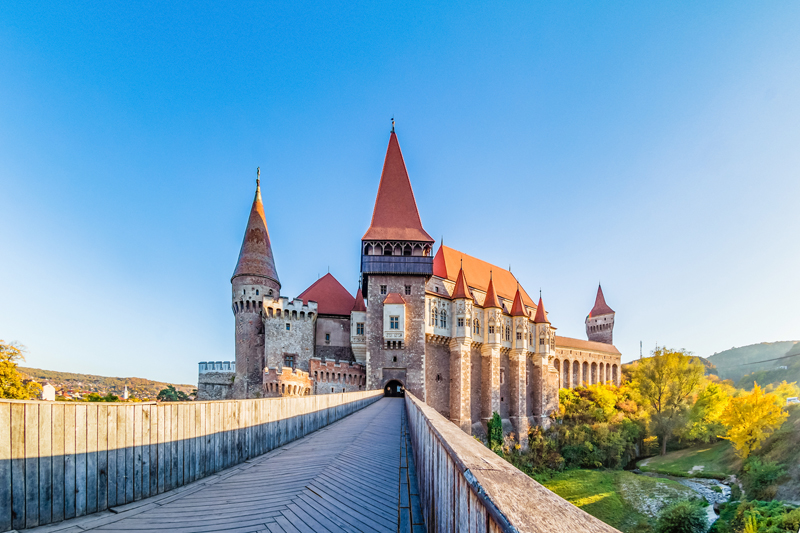
Corvin Castle, Hunedoara, Romania
Castelul Corvinilor, or Corvin Castle, seems plucked straight from the pages of a medieval epic. Nestled amid the rolling mist-shrouded hills of Transylvania, this Gothic masterpiece evokes a blend of foreboding grandeur and otherworldly charm. Begun in 1446 under the command of John Hunyadi (known in Romanian as “Ioan of Hunedoara”), the castle transformed an early Renaissance stronghold into a feat of defensive ingenuity. Towering double walls, a dramatic drawbridge, and an array of rectangular and circular towers fortified it against even the most advanced weaponry of the era. The castle’s imposing architecture remains a testament to Hunyadi’s strategic prowess and ambition.
Beyond its austere exterior, Corvin Castle reveals a more opulent and storied interior. Clad in gleaming marble, the Diet Hall served as a venue for elaborate receptions; the Knights’ Hall hosted feasts fit for nobility. For those fascinated with darker tales, the dungeon and torture chamber offer chilling insights into medieval justice, while the infamous “bear pit” is steeped in grisly legend. Open to visitors year-round, the castle invites modern-day explorers to immerse themselves in its history. Special rooms are available for private hire, and each summer’s Medieval Festival brings knights, jousting, and pageantry to life, making Corvin Castle a vibrant celebration of the past. castelulcorvinilor.ro
Château de Vaux-le-Vicomte, Maincy, France

Located just outside of Paris, the 17th-century Château de Vaux-le-Vicomte is a dazzling precursor to the grandeur of Versailles. Commissioned in 1658 by Nicolas Fouquet (Louis XIV’s superintendent of finance), this domed-roof estate epitomizes harmony between architecture, interior design, and landscaping. Fouquet spared no expense in hiring Louis Le Vau, Charles Le Brun, and André Le Nôtre, the creative trio later tasked by Louis XIV to design Versailles itself. Ironically, the château’s magnificence contributed to Fouquet’s downfall, as his lavish expenditures led to his arrest and imprisonment.
Though it was Versailles that became an iconic symbol of France, Château de Vaux-le-Vicomte rivals its contemporary as the foremost example of 17th-century French architecture and landscape design. Unlike the archetypal medieval and Renaissance châteaux found in regions like Périgord or Languedoc, Vaux-le-Vicomte does not have a moat or battlements. Despite the “castle” name, Vaux-le-Vicomte is in fact an unfortified palace, built long after the period of true castles. The French word for castle, “château,” was carried through the ages to have a broader meaning that incorporated palaces and mansions of later centuries. In this vein, many French châteaux do not fit the classic mold of their European peers.
Run today as France’s largest private historic property, Château de Vaux-le-Vicomte is open to the public from spring to early fall (in 2026, March 14 to Nov. 1) and again during select days of the holiday season. On Saturdays from May 16 to Sept. 26, the estate will host weekly Candlelit Evenings, when the palace will be illuminated by thousands of candles. Patrons have the option of dining next to the twinkling gardens at the estate’s Les Charmilles restaurant, which is open exclusively on these evenings. Pro tip: Book months
in advance. vaux-le-vicomte.com
Predjama Castle, Predjama, Slovenia

Perched within the mouth of a cliffside cave, Predjama Castle defies expectations as much as gravity. Overlooking Slovenia’s River Lokva, this four-story marvel intertwines natural formations and human craftsmanship in a way few castles can claim.
Its lore is inseparable from Erazem Lueger, a 15th-century knight famed for his daring exploits and Robin Hood–like defiance of authority. Despite a prolonged siege by Austrian forces during the Austrian-Hungarian War, the knight outwitted his enemies through a concealed passage within the cave system, enabling him to secure supplies and continue his rebellious escapades — until betrayal revealed a fatal vulnerability: the toilet. According to legend, his garderobe (a medieval-era toilet) was one of the castle’s few structural weak points, and it was there that he met his infamous end after a confidante alerted enemy forces of his whereabouts.

Rebuilt in 1570 with Renaissance refinement, Predjama Castle retained its fortress roots while adopting a more regal character. Nowadays, visitors can explore the castle’s richly atmospheric interiors as well as sections of the extensive cave system beneath it, which extends more than eight miles.
For the adventurous, guided tours delve into Erazem’s secret passage or the labyrinthine Eastern Passages, a trek not for the fainthearted or claustrophobic. The castle is open year-round, though cave access is seasonal to protect its resident bat colonies.
postojnska-jama.eu
Trakai Island Castle, Trakai, Lithuania

Rising from the tranquil waters of Lake Galvé, Trakai Island Castle is a fairy tale of medieval architecture set against the backdrop of Lithuania’s natural beauty. Originally constructed in the 14th century as a strategic partner to Grand Duke Kęstutis’s mainland fortress, the castle reached its zenith under the rule of Vytautas the Great. By the late 14th century, this red-brick Gothic stronghold featured a six-story donjon surrounded by its own protective moat — a defense innovation that set it apart.

The castle’s military prominence peaked during the Battle of Grunwald in 1410, when Vytautas’s forces, allied with Poland, achieved a decisive victory against the Teutonic Knights. Following this pivotal moment, Trakai Island Castle shifted from a military bastion to a luxurious ducal residence, adorned with impressive frescoes and intricate detailing that reflected its newfound role. Today, Trakai Island Castle enchants visitors year-round, though it’s particularly lively in the summer, when medieval festivals and open-air concerts fill its courtyards. The serene beauty of the island and its compelling past make it a must-see destination for history enthusiasts and travelers alike. trakaimuziejus.lt
Trakai Island Castle, Trakai, Lithuania

Situated near the English-Scottish border, Caerlaverock Castle is a striking testament to medieval resilience and ingenuity. Its triangular layout, unique in Britain, is both a defensive and architectural anomaly, featuring a wide moat, twin-towered gatehouse, and imposing curtain walls. Built in the 13th century, the castle’s tumultuous history includes multiple sieges as it changed hands between England and Scotland over the centuries. Edward I famously captured it in 1300, though the Maxwell family (its enduring Scottish lords) reclaimed it time and again until 1640, when it was abandoned as
a military stronghold.
Caerlaverock’s history is not merely one of warfare. The Maxwells’ personal chronicles tell a colorful tale of familial rivalries, political intrigue, and murder, adding depth to the castle’s already dramatic legacy. Today, its ruins offer visitors a chance to wander through history, marveling at its rare trilateral design and evocative surroundings. Open year-round, Caerlaverock is a poignant reminder of Scotland’s storied past, inviting exploration and reflection. historicenvironment.scot